Adapting the Semiconductor Industry’s Three-Tier Model to Artificial Intelligence, Data, Robotics and Advanced Computing
The rapid development of artificial intelligence is creating a new industrial economy. AI is no longer simply a software industry. It increasingly depends on an integrated physical and digital infrastructure consisting of semiconductors, advanced manufacturing, data centers, cloud computing, energy, telecommunications networks, AI models, robotics, software, financial platforms and millions of entrepreneurs and workers.
This creates an important economic question:
How can the AI economy grow rapidly while allowing a broad population—not just a small number of technology companies and investors—to participate in the ownership and economic benefits created by that growth?
A useful framework for examining this question is the three-tier semiconductor business model proposed by Apek Mulay in 2013. The original model divided the semiconductor ecosystem into an Upper Industrial Tier, Middle Industrial Tier and Lower Industrial Tier, connected through decentralized business relationships and broader employee ownership. The model argued that highly capital-intensive industries could coexist with a decentralized ecosystem of smaller businesses rather than concentrating the entire value chain in a few vertically integrated corporations.
The AI economy provides an opportunity to extend that concept.
The resulting framework can be described as Mass Capitalism 2.0: a market-oriented industrial system in which large-scale infrastructure remains economically necessary, but the innovation, entrepreneurship, employment and ownership opportunities surrounding that infrastructure are deliberately distributed across multiple layers of the economy.
From the Semiconductor Economy to the AI Economy
The semiconductor industry provides a particularly useful precedent because semiconductor production itself evolved from vertically integrated corporations toward a much more specialized ecosystem.
Historically, an integrated device manufacturer could design, manufacture, package and sell its own chips. Over time, the industry developed the fabless-foundry model: one company could specialize in chip design while another specialized in manufacturing. Outsourced semiconductor assembly and test companies could perform additional stages of production.
The OECD describes this specialization as one of the defining characteristics of the modern semiconductor value chain. Fabless companies design chips, foundries manufacture them, and OSAT companies perform assembly and testing. Some companies continue to operate integrated or “fab-lite” models.
This specialization matters economically because a company does not necessarily need to own every asset required to participate in the industry.
A semiconductor entrepreneur can therefore concentrate on:
- chip architecture;
- circuit design;
- software;
- intellectual property;
- testing;
- applications;
- customer relationships;
- specialized engineering;
while relying on other companies for capital-intensive manufacturing.
That structure created a powerful economic principle:
Large industrial infrastructure can coexist with a decentralized ecosystem of smaller innovative businesses.
My 2013 three-tier proposal attempted to apply that principle more broadly. This model placed advanced wafer fabrication in the Upper Tier, smaller fabless and engineering businesses in the Lower Tier, and cooperative mid-sized businesses connecting the two in the Middle Tier. The same architecture can be extended from semiconductors to AI.
Why AI Requires a Three-Tier Industrial Structure
AI has a similar economic architecture, but on a much larger scale. An advanced AI system requires several layers of capital and technology:
Electricity → semiconductor manufacturing → processors → data centers → cloud infrastructure → AI models → AI agents → applications → consumers and businesses
The capital requirements also differ dramatically between these layers. Building an advanced semiconductor fabrication plant can require enormous, fixed investment. Modern AI data centers similarly require large investments in computing equipment, power generation and transmission, cooling systems, networking and real estate. At the other end of the spectrum, an entrepreneur can potentially build an AI application with a comparatively small amount of capital. This creates an obvious economic asymmetry.
The infrastructure is capital intensive, but the Innovation can be capital light.
That distinction is central to Mass Capitalism 2.0. The objective is not to eliminate large corporations nor is it to make every business small. Instead, the objective is to create economic interfaces between large infrastructure and decentralized entrepreneurship.
The Three-Tier AI Industrial Model
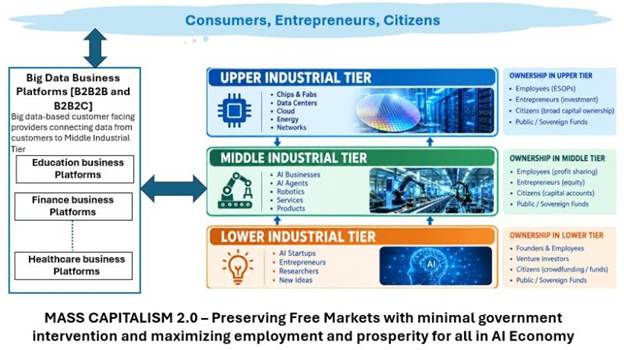
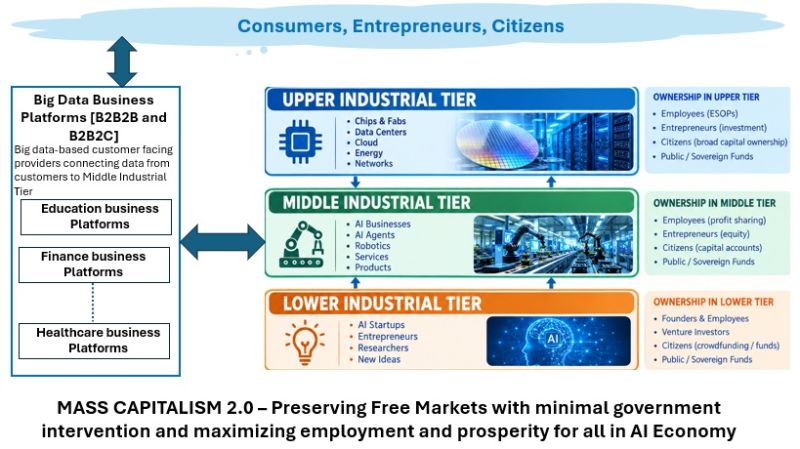
Figure 1- The Three-Tier AI Industrial Model
The proposed AI economy can therefore be organized into three interconnected industrial tiers
Upper Industrial Tier
Chips, fabs, data centers, cloud, energy and networks
Middle Industrial Tier
AI businesses, AI agents, robotics, products and services
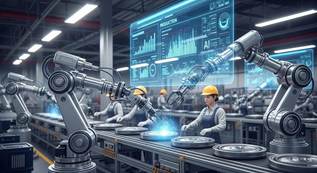
Lower Industrial Tier
AI startups, entrepreneurs, researchers and new ideas

A fourth component sits alongside these tiers:
Business Platforms
Big-data, education, finance, healthcare and other platforms
These platforms connect consumers, entrepreneurs and citizens with the industrial economy.
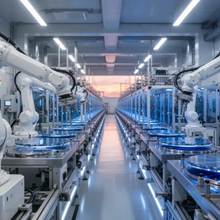
Upper Industrial Tier: The Physical Foundation of AI
The Upper Industrial Tier represents the capital-intensive foundation of the AI economy.
It includes:
- semiconductor fabs;
- advanced processors;
- memory;
- semiconductor equipment;
- data centers;
- cloud infrastructure;
- electricity generation using nuclear reactors;
- electricity transmission;
- cooling infrastructure;
- fiber-optic networks;
- telecommunications;
- specialized industrial facilities.
This layer resembles the Upper Tier in my semiconductor model, where the advanced wafer fab was positioned as the capital-intensive industrial foundation upon which smaller businesses could develop. The economics of this layer are fundamentally different from those of an AI application startup.
An entrepreneur might establish an AI software company with a relatively modest amount of capital. Building a leading-edge semiconductor fab, however, requires billions of dollars and specialized infrastructure. Even semiconductor companies increasingly rely on specialized foundries because of these enormous economies of scale. The same principle applies to AI data centers.
A modern AI ecosystem requires enormous quantities of:
capital + electricity + computing + networking + cooling + physical infrastructure.
Therefore, Mass Capitalism 2.0 does not attempt to decentralize everything.
Instead, it recognizes that some infrastructure is inherently large-scale and it would need government support. But government support means utilization of local tax dollars or tax breaks. This should be compensated for by having residents have a stake in these huge capital-intensive businesses and should also be able to reap the profits from operations. Besides, they should be able to voice their concerns and those should be addressed in local town hall meetings by these businesses. Failing to do so would result in penalties being imposed on businesses. This would ensure that the businesses are accountable to the residents when it comes to environmental safety, cleanliness of water and air.
The Upper Tier Should Become an Economic Platform
The crucial conceptual change is to think of the Upper Tier not merely as a collection of giant corporations but as an industrial platform. A semiconductor fab provides manufacturing capacity to numerous chip designers.
Similarly, an AI data center can provide computing capacity to:
- AI startups;
- research organizations;
- universities;
- enterprise AI companies;
- robotics companies;
- healthcare companies;
- financial companies;
- educational companies.
This produces an important economic multiplier.
Instead of one large company capturing the entire economic opportunity, the infrastructure becomes a foundation upon which thousands of businesses can operate. The semiconductor industry’s foundry business model provides a useful analogy: foundry capacity can serve many chip designers rather than only the company owning the fab.
Ownership in the Upper Tier
The original three-tier semiconductor proposal placed considerable emphasis on employee ownership and profit sharing.
In the AI version, ownership could potentially come from several sources:
- employees through ESOPs or similar arrangements;
- private investors;
- entrepreneurs;
- pension and retirement funds;
- citizens through investment accounts;
- public or sovereign investment funds.
The objective would be to create multiple channels of ownership rather than assuming that all capital appreciation must accrue to a narrow group of founders and external investors. This does not require abandoning private capital. Instead, private capital remains an important source of financing while employees and potentially broader pools of citizens participate in ownership. The original semiconductor proposal similarly argued that employee participation in ownership could give workers a direct stake in corporate performance. The important aspect of the Upper Industrial Tier is that since it is extremely capital intensive, local, state or federal government should own at least 51% stake in the business. The remaining stake can be through other channels of ownership. This would ensure that businesses follow the laws and regulations to protect residents as well as benefit from receiving tax subsidies for their operation.
Middle Industrial Tier: The Engine of the AI Economy
The Middle Industrial Tier is arguably the most important part of the Mass Capitalism 2.0 framework. It sits between enormous infrastructure companies and decentralized entrepreneurs.
The Middle Tier includes:
- AI businesses;
- AI agents;
- robotics;
- industrial automation;
- AI-enabled products;
- professional services;
- software platforms;
- specialized enterprise applications;
- AI-enabled manufacturing;
- healthcare applications;
- financial technology;
- education technology.
Its economic function is to convert computing infrastructure into products and services that customers use. This is analogous to the role assigned to the Middle Tier in my semiconductor proposal: connecting the upper industrial infrastructure to lower-tier businesses and end customers.
Why the Middle Tier Matters So Much
Consider a simplified AI supply chain:
Semiconductor Fab
↓
GPU / AI Processor
↓
Data Center
↓
Cloud Computing
↓
AI Model
↓
AI Agent
↓
Business Application
↓
Customer
The Upper Tier may manufacture the infrastructure.
The Lower Tier may invent new technologies.
But the Middle Tier transforms those technologies into commercially useful products.
For example:
An AI semiconductor becomes economically valuable when somebody uses it to power:
- an autonomous robot;
- a medical diagnostic system;
- a financial-analysis platform;
- an industrial optimization system;
- an educational platform;
- a logistics system;
- a manufacturing application.
Therefore, the Middle Tier is where technological capability becomes economic productivity.
AI Agents as the New Industrial Machinery
One major difference between the semiconductor economy of 2013 and the AI economy of today is the emergence of AI agents. Traditional software primarily provides tools. AI agents can increasingly perform workflows.
An AI agent could potentially:
- analyze data;
- write software;
- communicate with customers;
- operate business systems;
- conduct research;
- optimize manufacturing;
- manage logistics;
- assist engineers;
- generate designs.
Consequently, AI agents can be viewed as a new form of digital industrial machinery. The economic significance is substantial. A small company may be able to perform work that previously required much larger organization. This potentially lowers barriers to entrepreneurship. The Middle Tier therefore becomes a mechanism through which AI capabilities are converted into productivity throughout the broader economy.
Lower Industrial Tier: The Entrepreneurial Economy
The Lower Industrial Tier represents the decentralized innovation ecosystem.
It includes:
- AI startups;
- entrepreneurs;
- researchers;
- university laboratories;
- independent developers;
- specialized engineering firms;
- new product concepts;
- experimental AI applications.
This layer is essential because large corporations generally cannot predict every successful future application of technology. Thousands of entrepreneurs can experiment simultaneously. Most experiments will fail. Some will survive. A few may become major businesses. This is one of the fundamental advantages of decentralized markets. The original semiconductor proposal similarly envisioned smaller fabless companies and specialized engineering businesses as a decentralized Lower Tier.
The Lower Tier Should Not Have to Own the Entire Infrastructure
A major advantage of the three-tier model is that a startup does not need to own everything.
An AI startup should not necessarily need to build:
- a semiconductor fab;
- a data center;
- a power plant;
- a telecommunications network;
- an AI accelerator.
Instead, it can rent or purchase access to those resources. This produces a capital-leverage effect. A $5 million startup might potentially access billions of dollars of infrastructure through cloud and industrial platforms.
The entrepreneur contributes:
ideas + intellectual property + management + customer knowledge + innovation.
The Upper Tier contributes:
computing + energy + chips + networks + physical infrastructure.
The Middle Tier contributes:
integration + products + distribution + services.
This is the fundamental architecture of Mass Capitalism 2.0.
Big Data Business Platforms
The diagram introduces another important component: Big Data Business Platforms.
These platforms sit alongside the three industrial tiers.
They include:
B2B/B2B2C platforms
Connecting industrial businesses with customers and other businesses. These platforms can become the information layer connecting consumers, entrepreneurs and industrial companies. The key resource is no longer merely physical capital. It is increasingly:
data + computing + knowledge + capital + human creativity.
Consumers Become More Than Consumers
A central concept in the proposed model is that people occupy multiple economic roles.
A person can simultaneously be:
Consumer + Worker + Entrepreneur + Investor + Citizen
This is important because technological productivity does not automatically translate into broad purchasing power. If productivity increases dramatically while purchasing power becomes concentrated among a small ownership group, the economy can encounter a demand problem.
The original semiconductor proposal explicitly connected worker productivity, wages and consumer demand, arguing that an economy requires sufficient purchasing power to absorb the goods and services it produces. Mass Capitalism 2.0 extends this argument into the AI era.
From Wage Income to Ownership Income
AI creates a difficult question:
If machines and AI systems perform an increasing percentage of economic work, how should ordinary citizens participate in the resulting wealth creation?
One answer is simply to redistribute income after production.
Mass Capitalism 2.0 proposes a different emphasis: Broaden ownership of productive capital.
That could involve:
- employee stock ownership;
- profit-sharing;
- retirement investment;
- citizen investment accounts;
- entrepreneurial equity;
- cooperative ownership;
- public investment funds;
- sovereign wealth participation.
The objective is to make people participants in the productive capital that generates AI-era wealth. This differs conceptually from treating citizens solely as recipients of government transfers. This would eliminate any like of doles like Universal Basic Income or Universal High Income as proposed by Elon Musk. In fact, By having a stake in the business would incentivize the masses to ensure success of their business as well as minimize the environmental damage.
Mass Capitalism Versus a Purely Transfer-Based Model
A transfer-based economic response to automation might operate as follows:
AI → higher productivity → fewer workers → government transfers income to displaced workers
Mass Capitalism 2.0 proposes another pathway:
AI → higher productivity → new businesses → broader capital ownership → higher investment income + new employment + new consumption
The distinction is important.
The first approach primarily addresses income distribution after production. The second attempts to influence ownership and participation in production itself. This is why the model places ownership directly into each industrial tier.
Employee Ownership
Employee ownership is particularly important in capital-intensive industries. Consider a large data center or semiconductor manufacturing operation.
Employees include:
- engineers;
- technicians;
- operators;
- maintenance workers;
- software engineers;
- facility managers;
- security personnel;
- logistics specialists.
If these employees participate in ownership, the economic relationship changes.
Instead of:
Company → employees
it becomes:
Company ↔ employee-owners
Employees receive wages for their work while potentially participating in the financial performance of the enterprise. The original semiconductor model proposed employee participation in company ownership and profit sharing as a mechanism for connecting productivity with compensation.
Entrepreneurial Ownership
The second ownership channel is entrepreneurial equity. Lower-tier entrepreneurs create new businesses. If their businesses succeed, founders and early employees can own substantial portions of the resulting enterprise. This creates a powerful incentive structure:
Innovation → equity creation → business growth → wealth creation
The important point is that entrepreneurial ownership can create new capital rather than simply reallocating existing wealth.
Citizen Ownership
The third ownership channel is broader citizen participation. The diagram proposes mechanisms such as:
- crowdfunding;
- investment funds;
- capital accounts;
- broad investment ownership.
The objective is not that every citizen individually owns a semiconductor fab or data center. Instead, citizens could potentially own diversified claims on productive assets through financial vehicles. This is conceptually similar to how millions of households already participate indirectly in corporate ownership through retirement accounts and mutual funds. Mass Capitalism 2.0 would seek to expand that principle into emerging AI infrastructure.
Public and Sovereign Funds
The diagram also includes public/sovereign funds as potential owners. This is particularly relevant for strategic infrastructure. Governments may determine that semiconductor manufacturing, energy infrastructure or AI computing capacity has national-security or economic importance. Instead of viewing public participation only as subsidies or expenditure, a public fund could potentially hold an ownership stake.
That creates a different relationship:
Government → capital investment → productive asset → financial return
rather than simply:
Government → subsidy → expenditure
Whether such structures are desirable or effective depends on governance, investment discipline and the specific industry. But as a business-model concept, public investment can be viewed as another potential ownership mechanism.
Minimal Government Intervention Does Not Mean Zero Government
The phrase “minimal government intervention” in the diagram should not be interpreted as an absence of government. A modern semiconductor and AI ecosystem requires government functions such as:
- property rights;
- contract enforcement;
- competition policy;
- infrastructure planning;
- education;
- basic research;
- national security;
- standards;
- financial regulation;
- environmental regulation.
The distinction is between government establishing the rules and infrastructure of the regulatory environment as compared to government attempting to operate every business directly. The original semiconductor proposal similarly envisioned infrastructure support and economic policy while retaining competitive businesses and decentralized decision-making. Since tax payers have to subsidize the huge infrastructure investments, the same tax payers should have rightful equity stake in these businesses and should benefit from the growth in profits of these infrastructure businesses.
Competition Rather Than Permanent Protection
A central principle of the model is that large infrastructure should create opportunities for smaller businesses.
The semiconductor proposal specifically argued for decentralization of engineering and fabless businesses and greater competition among specialized business units.
Applied to AI, this means an AI infrastructure company could provide standardized access to:
- compute;
- networking;
- storage;
- AI accelerators;
- model APIs;
- data services.
Then hundreds or thousands of companies can compete at the application level. The resulting competition occurs above the infrastructure layer rather than requiring every company to replicate the infrastructure itself. Anti-Trust laws should be strictly enforced to avoid formation of oligopolies in industry and to keep healthy competition in the economy to restore free markets.
The “Platform + Ecosystem” Principle
This produces one of the most important concepts in Mass Capitalism 2.0:
Large-scale infrastructure should become a platform for decentralized entrepreneurship.
The semiconductor foundry provides manufacturing capacity. The cloud provides computing capacity. The data center provides physical computing capacity. The electricity system provides energy capacity. The financial platform provides capital. The education platform provides human capital. Entrepreneurs combine these resources to create new businesses. This creates an economic ecosystem rather than a single vertically integrated corporation.
AI Can Potentially Create a New Entrepreneurial Multiplier
Suppose one large AI infrastructure company supports: 10,000 AI entrepreneurs
and each entrepreneur employs or contracts with 20 people.
That produces an ecosystem supporting approximately:200,000 jobs
without requiring the infrastructure company itself to employ 200,000 people.
This is an illustrative example—not a forecast—but it demonstrates the economic logic of the model. The employment multiplier comes from the ecosystem surrounding infrastructure, rather than solely from direct employment by the infrastructure owner. This is precisely why the Middle and Lower Tiers are important.
From Vertical Integration to Networked Industrialization
Traditional industrial capitalism often developed around vertical integration and centralized supply chains.
Raw materials → manufacturing → distribution → retail
A decentralized AI economy can instead resemble:
Infrastructure platform
↓
Thousands of specialized businesses
↓
Millions of consumers and enterprises
The resulting structure is more like an industrial network.
The semiconductor industry already demonstrates how specialization can produce such networks. The OECD notes that increasing specialization has created a highly complex and interdependent semiconductor value chain. AI can extend this principle across virtually every industry.
The AI Economy Is Becoming a General-Purpose Industrial System
Semiconductors were once a specialized technology.Today they are embedded in:
- automobiles;
- smartphones;
- computers;
- industrial machinery;
- medical equipment;
- telecommunications;
- defense systems;
- consumer electronics.
AI could follow a similar trajectory.
AI will potentially become embedded in:
- manufacturing;
- transportation;
- healthcare;
- education;
- finance;
- agriculture;
- logistics;
- entertainment;
- scientific research;
- professional services.
Consequently, the AI economy should not be viewed merely as the “AI software industry.”
It is better understood as an enabling infrastructure for the entire economy.
AI + Robotics Creates a Physical Industrial Layer
The addition of robotics to the Middle Tier is especially important. AI software can produce digital output. Robotics converts AI intelligence into physical action.
The combination becomes:
AI model + AI agent + robot + manufacturing system
This could transform factories, warehouses, agriculture, transportation and services. The Middle Tier therefore becomes the place where digital intelligence meets physical production.
The Economic Flywheel
The entire Mass Capitalism 2.0 model can be represented as a flywheel:
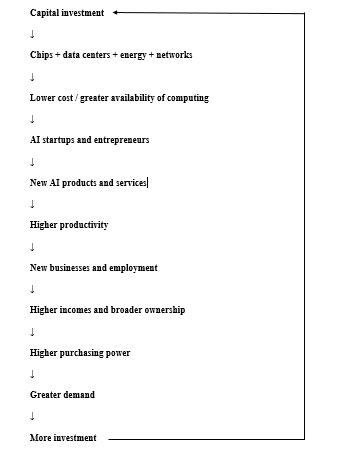
The goal is to create a self-reinforcing investment-and-demand cycle. This is only possible when supply and demand and kept in balance. Also, when the official monetary policy is for the wages to keep pace with productivity.
The Semiconductor Model’s Relevance Today
Interestingly, the semiconductor industry itself continues to evolve toward more specialized business models. Deloitte’s semiconductor research identifies an ongoing movement toward “everything-as-a-service”, including subscription, usage-based and outcome-based models across parts of the semiconductor value chain. This is highly relevant to AI.
AI infrastructure is increasingly consumed as a service: Compute-as-a-Service, AI-as-a-Service, Model-as-a-Service, Robotics-as-a-Service, Software-as-a-Service
The entrepreneur therefore does not necessarily need to purchase the entire production system. They can rent its capabilities. That makes decentralization increasingly practical.
The New Meaning of Capitalism
The term Mass Capitalism emphasizes that capitalism does not necessarily have to mean that productive capital is concentrated among a small number of owners.
The fundamental capitalist mechanism is:
private ownership + investment + entrepreneurship + competition + markets
The Mass Capitalism 2.0 proposal adds:
broader ownership participation + decentralized business formation + employee participation + accessible infrastructure.
Thus, the objective is not to eliminate capitalism. It is to broaden participation in capital ownership in order to minimize the unemployment, minimize income taxes and maximize the purchasing power in the economy to maximize economic demand.
A New Relationship Between Large and Small Businesses
The model does not view large corporations and small businesses as necessarily opposing forces.
Instead:
Upper Tier –Provides scale
Middle Tier –Provides commercial integration
Lower Tier –Provides innovation
The relationship becomes complementary. A large data center needs thousands of customers.
Those customers need specialized AI businesses. Those businesses need entrepreneurs and researchers. Entrepreneurs need access to computing and capital. Each tier therefore creates demand for the others.
Education Becomes Part of the Industrial System
The education platform in the diagram is particularly important. AI will continuously change the skills demanded by businesses. Therefore, education cannot be isolated from the industrial economy.
A more integrated system could connect:
University → Research → Startup → Industry → Employment
A researcher develops technology. An entrepreneur commercializes it. An industrial company becomes a customer. Employees develop additional expertise. The cycle creates human capital.
This resembles the university-industry collaboration envisioned in the original semiconductor model, where universities, fabs and emerging companies could cooperate in research and entrepreneurship.
Finance Becomes the Circulatory System
The financial platform provides the capital necessary to move ideas through the three tiers.
Capital could flow:
Citizens → investment funds → infrastructure
Investors → startups
Employees → company equity
Entrepreneurs → new enterprises
Profits → reinvestment
The objective is to keep productive capital circulating rather than allowing investment opportunities to remain accessible only to large institutional investors.
Healthcare as an AI Industrial Ecosystem
Healthcare provides a useful example of how the model could work.
Upper Tier
- data centers;
- semiconductor infrastructure;
- secure networks.
Middle Tier
- AI diagnostic companies;
- medical AI platforms;
- robotic systems;
- hospital software.
Lower Tier
- researchers;
- university startups;
- specialized medical AI companies.
Platform Layer
- patient data;
- education;
- finance;
- healthcare delivery.
The same architecture can be applied to education, manufacturing, logistics and financial services.
The Model Is Not Without Risks
Concentration of computing
A small number of companies may control advanced chips, cloud capacity and AI models. To avoid this Anti-Trust laws must be strictly enforced. Also, the Upper tier should have larger stake among the local taxpayers. In order the Capital-intensive business to be sustainable, it is extremely important that government should be able to subsidize the increasingly heavy capital investments. However, the tax breaks give to businesses should not cause a deficit in local economy. Hence, the profits from the operations should go first to the largest shareholder, which is the local government. If this produces a surplus in local economy, then it could be used to build better infrastructure to enhance the livelihood without having to create a lot of debt to pay for improving the livelihood of citizens.
Capital intensity
Advanced semiconductor fabs and data centers require enormous capital. Hence, support from the state and federal government is extremely important to keep this business sustainable.
Energy constraints
AI infrastructure requires substantial electricity. There would be need to nuclear energy in future which would be possible with government support.
Network effects
Successful platforms can become increasingly difficult for competitors to challenge. Although this would be true, the way data platforms compensate their owners; wealth tax could be introduced to avoid extreme inequality in the economy. The minimum necessities and maximum amenities as elaborated in my book ‘How The Information Revolution Remade the Business and the Economy – A Roadmap for the Progress of Semiconductor Industry’ should be implemented.
Intellectual property concentration
A small number of firms could accumulate valuable AI models, data and patents. There should be a shorter expiry date for the patents. It should be possible to license the AI model from competitors by sharing revenue with them. Businesses should be spit into smaller independent businesses by enforcing Anti-Trust laws.
Financing risk
Not every startup can generate sustainable economic value merely because it uses AI. Startup failures should become a business school case study to understand the reasons for their failures and what can be learnt from their mistakes. Education platforms should have all the data available to understand the causes of failure of startups. This data can generate intelligence that could be used by entrepreneurs to minimize future failures. Failures should not be looked down but failed startup can always share their knowledge and causes for failures to get compensated by education platforms for their contributions.
Governance
Employee and citizen ownership requires transparent governance and effective financial management. These are design challenges, but they can be addressed by citizens who vote for candidates in elections.
Competition Policy Becomes Critical
The three-tier system requires competitive markets. If the Upper Tier becomes closed and inaccessible, the model could evolve toward oligopoly. Hence, 51% stake by government is important to have oligopolies in industry. A successful business at Upper Tier should be able to make additional revenue by licensing their technology for use by their competitors. This would prevent one of two big businesses from dominating the entire upper tier. There should be term limits on the expiration of the technology licensing by up to 2 years. This would prevent one business from driving the other out of business. It would also buy time for the trailing business to catch up by investing extra efforts in R&D while not losing revenue. In present economy, a few oligopolies dominate in this business which has resulted in monopoly capitalism as compared to free market capitalism.
If the Middle Tier consolidates excessively, entrepreneurs could lose access to customers. Hence, Ownership structure should be neo-cooperative. These neo-cooperative businesses which are owned by their stake holders or employees of the business. The ownership structure in Middle Tier can let the business grow big but the rewards would be reaped by joint ownership of employees in proportion to their productive contributions. Because of decentralized growth, there is very little chance for entrepreneurs to lose access to customers. Besides, the Federal Anti-Trust laws play a very important role here to avoid any kind of anti-competitive growth of business.
If the Lower Tier is dominated by acquisitions, independent innovation could decline. Therefore, competition policy becomes an important part of architecture. The original semiconductor proposal similarly emphasized decentralization and concern about excessive mergers and acquisitions as a mechanism for preserving competitive opportunities. Modern implementation would need to distinguish between productive scale and anticompetitive concentration rather than assuming that either large firms or all acquisitions are inherently harmful.
The Model and the Future of Employment
The ultimate employment question is not simply: “Will AI eliminate jobs?”
A more useful question is: “How many new economic activities can emerge because AI reduces the cost of intelligence?”
If AI makes software development cheaper, more software businesses may emerge. If AI makes engineering cheaper, more specialized engineering businesses may emerge. If AI makes robotics cheaper, more automated factories may become economically viable. If AI reduces the cost of medical research, more healthcare applications may become possible. Therefore, the economic effect depends partly on whether society allows the resulting productivity gains to generate new businesses and new demand.
Productivity and Purchasing Power
This brings us back to the macroeconomic principle underlying my original semiconductor proposal.The proposal emphasized the relationship:
Worker productivity → income → purchasing power → demand → production
The AI era introduces another variable:
AI productivity → capital income + labor income → purchasing power → demand
If AI dramatically increases output but ownership of AI capital remains extremely concentrated, the distribution of purchasing power becomes an important macroeconomic issue. Broadening ownership is therefore one possible mechanism for allowing more households to participate in the returns generated by AI capital.
Why the Three-Tier Structure Is Different from Traditional Corporate Capitalism
Traditional corporate capitalism often emphasizes the corporation as the primary economic unit.
Mass Capitalism 2.0 emphasizes the ecosystem.
The unit of analysis becomes: Infrastructure + businesses + entrepreneurs + workers + consumers + investors
rather than simply: Corporation + shareholders
This is particularly appropriate for AI because no single company controls every part of the technology stack.
A Possible Ownership Architecture
The model in the diagram can therefore be summarized as follows:
| Economic Tier | Primary Function | Potential Ownership |
| Upper | Chips, fabs, data centers, energy, networks | Employees, private investors, citizens, public/sovereign funds, local government (majority) |
| Middle | AI businesses, agents, robotics, products, services | Employees (majority), entrepreneurs, citizens, investors |
| Lower | Startups, entrepreneurs, researchers, ideas | Founders (majority), employees, venture investors, citizens, public funds |
| Platforms | Data, education, finance, healthcare | Private companies, cooperatives (majority), users , investors, public institutions |
This produces a diversified ownership architecture rather than a single ownership model.
From Moore’s Law to “Mass Capitalism 2.0”
The semiconductor industry was transformed by a technological feedback loop:
More transistors → lower cost per unit of computing → more applications → greater demand → more investment → more technological progress
AI may create a similar loop:
More computing → better AI → lower cost of intelligence → more entrepreneurs → more applications → higher productivity → greater demand for computing → more investment
The critical economic question becomes:
Who owns the productive assets participating in this feedback loop?
Mass Capitalism 2.0 provides one possible answer:
Ownership should exist at multiple levels—employees, entrepreneurs, investors, citizens and public funds, while competitive markets determine which businesses succeed.
The Central Principle
The central idea can ultimately be reduced to one sentence:
Do not attempt to make every industrial asset small; instead, make large industrial assets accessible to a large ecosystem of small and medium-sized businesses. Also, let the gains be shared by the stakeholders of the business so that there is a broader economic prosperity.
This is the major lesson that can be carried from the semiconductor three-tier model into the AI economy. A semiconductor fab can remain enormous. A data center can remain enormous. Power facility can remain enormous. But the businesses using those assets can be numerous and decentralized. That distinction allows scale in infrastructure and decentralization in entrepreneurship to coexist.
Conclusion: From Concentrated AI to an AI Economic Ecosystem
The semiconductor industry’s evolution provides a powerful historical analogy for understanding the possible organization of the AI economy.
The industry demonstrated that highly capital-intensive manufacturing could coexist with specialized companies operating at different points in the value chain. Modern semiconductor production is characterized by complex interdependence among fabless designers, foundries, IDMs, equipment companies and assembly/test providers.
The proposed Mass Capitalism 2.0 model extends that architecture.
Its structure is:
UPPER TIER
Chips + Fabs + Data Centers + Cloud + Energy + Networks
↓
MIDDLE TIER
AI Businesses + AI Agents + Robotics + Products + Services
↓
LOWER TIER
Startups + Entrepreneurs + Researchers + New Ideas
with
BIG-DATA PLATFORMS
connecting the industrial system to:
CONSUMERS + ENTREPRENEURS + CITIZENS
And running through the entire system is a second dimension:
OWNERSHIP
Employees + Entrepreneurs + Citizens + Investors + Public/Sovereign Funds
The fundamental economic proposition is therefore not that large corporations should disappear. It is that large-scale infrastructure and decentralized capitalism can coexist. The Upper Tier supplies scale. The Middle Tier supplies commercialization. The Lower Tier supplies experimentation and innovation. The platform layer supplies information, finance and human capital. And broad ownership potentially allows a larger share of society to participate in the wealth created by the resulting productivity.
That is the conceptual bridge from my three-tier semiconductor business model of 2013 to a proposed Mass Capitalism 2.0 architecture for the AI economy. The original three-tier semiconductor structure around economic decentralization, employee participation and a supply chain connecting smaller businesses with capital-intensive semiconductor infrastructure.
The semiconductor industry has since become even more specialized and interconnected, while AI is creating an additional layer of demand for chips, data centers, energy and software. McKinsey’s 2026 analysis, for example, projects substantial semiconductor growth through 2030 as AI drives datacenter and edge-computing demand.
Mass Capitalism 2.0 can therefore be understood as an attempt to answer the next economic question:
If AI becomes the most important general-purpose technology of the next industrial era, how can society combine the enormous economies of scale required by AI infrastructure with the decentralized entrepreneurship, employment and ownership required for a broad-based market economy?
That is the economic problem the three-tier model is designed to address. However, the model is incomplete without enforcing laws and regulations. But It would usher in broader economic well being for entire mankind and ensure that free markets are preserved with minimal government intervention and economic prosperity is maximized. As mentioned in my other books, this model would overcome the boom and busts in the economy and avoid huge layoffs during economic downturns resulting in abundant economic prosperity. It would lead to a New Renaissance in the Global Economy.
References –
- A Three-Tier Business Model for the Industry, 6 Dec 2013, PROUT Globe
- The next era of semiconductor value creation, 30 March 2026, Marc de Jong and Syed Alam, with Bas Gerdsen and Yvonne Ferrier, representing views from McKinsey’s Semiconductors Practice.
- Mapping the Semiconductor Value Chain, Jan-Peter Kleinhans, Mario Alejandro Nieves, Sara Romaniega Sancho, and Charles-Édouard van de Put, OECD SCIENCE, TECHNOLOG AND INDUSTRY POLICY PAPERS, June 2025 No. 182
- Semiconductor Transformation Study 2.0, Deloitte, Brandon Kulik, Sindhu Anand, Dhruv Mehta, Dan Hamling
- A Semiconductor Strategy for the United States, October 2022, Christopher A Thomas
About the Author
Apek Mulay comes from business and technology background. He holds twin master’s degrees in electrical engineering and business Analytics. Apek is an author of 6 books on business and economics. He was cited as engineer-cum-economist by superstar economist late Professor Ravi Batra in his 2015 book ‘End Unemployment Now’. Apek serves on the board of directors for ‘Flying Metals’ which is a privately held company catering to supply chains for Global Aerospace industry. USCIS granted him US Permanent residency under the category of foreign nationals with extraordinary www.apekmulay.com capabilities in fields of science and technologies although he did not pursue a PhD degree in either engineering or economics. Apek holds Life and health, series 6, 63 as well as 65 licenses in financial industry. He also has certification as “Certified Plan Fiduciary Advisor” with NAPA (National Association of Plan Advisors). With his licenses, he offers fixed and variable life insurance, annuities, corporate 401K plans, Wealth management solutions, estate planning, charitable planning and many other advanced planning strategies. He has over 4 million hits on his personal blog. He has appeared on National Radio shows, Made Cover Story for Industry Magazines as well been on Television shows about his ideas on Mass Capitalism About Me and Mulay’s Consultancy Services | Apekshit Mulay
Recent Comments